
Overview
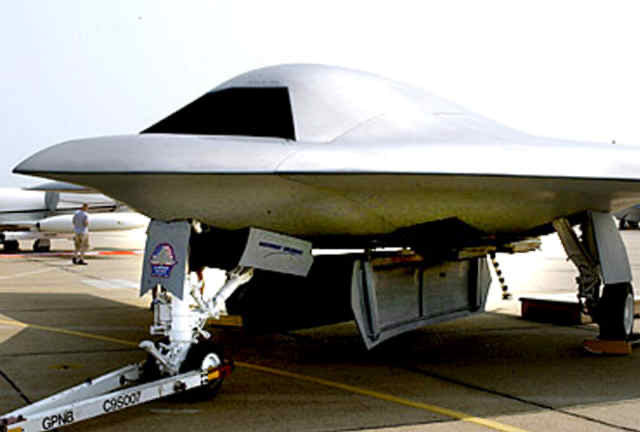
This entry covers gallery images that appear to show concept artwork or models of Boeing Blended-Wing-Body (BWB) aircraft. The BWB is a fixed-wing aircraft configuration in which the fuselage and wing are smoothly blended into a single lifting surface, with no distinct fuselage or tail. The BWB is derived from the flying-wing concept but incorporates a thicker centre body for passenger or cargo accommodation. The images are concept artwork or models, not photographs of operational aircraft, and their specific programme attribution cannot be verified from the images alone.
Boeing and NASA have studied BWB configurations since the 1990s as a potential next-generation transport aircraft configuration. The BWB offers potential advantages in aerodynamic efficiency, fuel consumption, and internal volume, but faces significant challenges in structural design, control, and integration with existing airport infrastructure.
Blended-Wing-Body Principles
The Blended-Wing-Body is a hybrid between a flying wing and a conventional tube-and-wing aircraft. In a BWB:
- The fuselage and wing are blended: There is no distinct junction between the fuselage and the wing. Instead, the centre body smoothly transitions into the outer wings, creating a single continuous lifting surface.
- The centre body generates lift: Unlike a conventional fuselage, which generates minimal lift, the BWB's centre body is shaped to generate a significant portion of the total lift.
- There is no vertical tail: Most BWB designs eliminate the vertical tail, relying on differential drag or split-rudder surfaces for directional control, similar to the B-2 Spirit.
The BWB configuration offers several potential advantages:
- Reduced wetted area: The blended configuration has less total surface area (wetted area) than a tube-and-wing aircraft of the same capacity, reducing skin-friction drag.
- Improved lift-to-drag ratio: The entire aircraft generates lift, improving the lift-to-drag ratio and reducing fuel consumption.
- Large internal volume: The thick centre body provides ample internal volume for passengers, cargo, or fuel.
- Potential for reduced radar cross-section: The smooth, tailless configuration can be designed for low observability.
Boeing BWB Programmes
Boeing has studied BWB configurations through several programmes:
NASA/B-2 derived studies: Initial BWB studies were conducted in the 1990s by NASA and McDonnell Douglas (later Boeing), building on the B-2 Spirit's flying-wing technology. These studies explored the application of BWB to large transport aircraft.
X-48 BWB Demonstrator: Boeing and NASA built and flew subscale BWB demonstrator aircraft under the X-48 designation:
- X-48B: Two 8.5%-scale unmanned demonstrators, built by Cranfield Aerospace and flown by NASA from 2007 to 2010. The X-48B demonstrated the basic feasibility of the BWB configuration.
- X-48C: A modified X-48 with a different engine configuration and improved low-noise design, flown from 2012 to 2013. The X-48C demonstrated noise reduction concepts for BWB aircraft.
The X-48 programme validated the flight characteristics of the BWB configuration and demonstrated that a BWB aircraft could be controlled using elevons and split-rudder surfaces without a vertical tail.
Commercial and Military Applications
The BWB configuration has been studied for both commercial and military applications:
Commercial transport: Boeing and NASA have studied BWB designs for future commercial transport aircraft, potentially offering 20-30% fuel efficiency improvement over conventional tube-and-wing designs. However, the BWB faces significant challenges for commercial application, including:
- Airport compatibility: The BWB's wide body would require modifications to airport gates, taxiways, and baggage handling systems.
- Passenger acceptance: The BWB's interior, with many seats far from windows, may be less attractive to passengers than conventional aircraft.
- Evacuation: Emergency evacuation of a BWB aircraft is more complex than a conventional tube-and-wing, with longer distances to exits.
- Certification: The BWB would require new certification standards, as existing standards are based on tube-and-wing aircraft.
Military transport: The BWB's large internal volume and potential for low observability make it attractive for military transport applications. Boeing has studied BWB designs for military cargo aircraft and aerial refuelling tankers.
Stealth applications: The BWB's smooth, tailless configuration can be designed for low radar cross-section, making it attractive for stealth applications.
Declassification and Provenance
The gallery images are concept artwork from a legacy compilation whose CIA-P2 catalog numbers are legacy identifiers and do not establish CIA authorship, declassification, or provenance. The images depict design concepts, not operational hardware, and should not be interpreted as evidence that any BWB aircraft has been deployed.
The images may originate from open-source Boeing and NASA publications, contractor studies, or popular-science illustrations. Without verified provenance, the images should be treated as historical concept art of unknown origin.
References
- NASA. "Blended Wing Body Research." NASA Aeronautics Research Mission Directorate.
- Boeing. "Blended Wing Body." Company technical publications.
- Liebeck, R.H. "Design of the Blended Wing Body Subsonic Transport." AIAA Journal of Aircraft.
- Chambers, Joseph. Innovation in Flight: Research of the NASA Langley Research Center on Revolutionary Advanced Concepts for Aeronautics. NASA.