
Overview
The Northrop Grumman B-2 Spirit is a long-range, low-observable strategic bomber operated by the United States Air Force. It is the only acknowledged operational flying-wing bomber in the world and represents the culmination of five decades of flying-wing research pioneered by Jack Northrop. The B-2 can deliver both conventional and nuclear munitions anywhere on earth from its home bases in the continental United States, penetrating sophisticated air-defence networks that would deny access to non-stealthy aircraft.
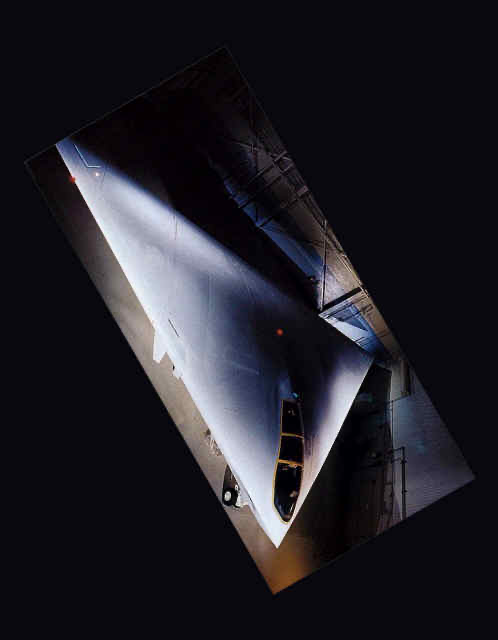
The aircraft's distinctive shape — a continuous flying wing with no fuselage and no vertical tail surfaces — is not an aesthetic choice but the geometric solution to the competing demands of aerodynamic efficiency, structural capacity, and broadband radar cross-section reduction. The B-2 entered service in 1997 and has participated in every major US bombing campaign since the Kosovo War in 1999.
Design and Low-Observable Technology
The B-2's airframe is a flying wing with a wingspan of 172 feet (52.4 m) and a length of 69 feet (21.0 m). The absence of a vertical stabiliser — impossible on a conventional aircraft — is made feasible by a sophisticated fly-by-wire flight-control system that continuously adjusts split-rudder surfaces to maintain directional stability. The aircraft's four General Electric F118-GE-100 non-afterburning turbofan engines are buried deep inside the wing structure, with their exhausts routed above the trailing edge to minimise infrared signature.
The radar cross-section of the B-2 has been variously reported as comparable to a small bird or a marble, though the exact figure remains classified. This is achieved through a combination of shape, materials, and coatings. The shape deflects incoming radar energy away from the receiver rather than back toward it. The leading and trailing edges, which would otherwise produce strong specular returns, are treated with radar-absorbent material (RAM). The aircraft's skin incorporates advanced composite materials and iron-ball paint formulations that absorb electromagnetic energy across multiple frequency bands.
Maintenance of the low-observable coatings remains one of the most expensive and logistically demanding aspects of B-2 operations. The aircraft require climate-controlled hangars — the B-2 Specific Support System (BSSS) — to preserve coating integrity, which historically limited forward-basing options. Improvements to coating durability in the Block 30 upgrade have reduced, though not eliminated, this constraint.
Development History
The B-2 originated in the Advanced Technology Bomber (ATB) programme, launched in 1979 by the Carter administration as a response to improving Soviet air-defence systems. The ATB requirement called for a bomber that could penetrate Soviet airspace undetected and deliver nuclear weapons against hardened targets.
Northrop Corporation was awarded the ATB contract in 1981, beating a competing design from a Lockheed-Rockwell team. The selection of Northrop was a vindication of Jack Northrop's flying-wing vision, which had been tested in the N-9M, YB-35, and YB-49 programmes of the 1940s but abandoned for lack of adequate flight-control technology. The advent of fly-by-wire systems made the flying wing practical for the first time.
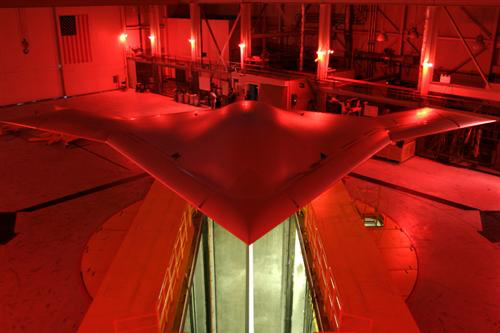
The first B-2, Spirit of America (AV-1, serial 82-1066), rolled out of Northrop's Palmdale, California facility on 22 November 1988 and first flew on 17 July 1989. The rollout was a public event, but the aircraft's planform was partially obscured from overhead view to protect classified design details — a measure that became moot when Aviation Week & Space Technology published an overhead photograph taken from a light aircraft.
The programme was controversial from the start. The end of the Cold War eliminated the original penetrating-nuclear-strike mission. Production was cut from an initial plan of 132 aircraft to 21 operational bombers. The total programme cost, including research and development, reached approximately $2.1 billion per aircraft — making the B-2 the most expensive aircraft ever built.
Operational History
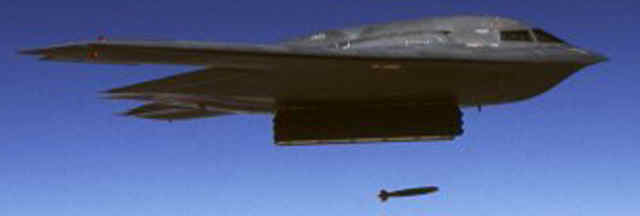
The B-2 achieved Initial Operational Capability (IOC) in April 1997 with the 509th Bomb Wing at Whiteman Air Force Base, Missouri. Its combat debut came in Operation Allied Force (the Kosovo War) in 1999, where B-2s flew non-stop 30-hour round-trip missions from Whiteman to Yugoslavia. The aircraft delivered JDAM (Joint Direct Attack Munition) guided bombs with notable precision, and the campaign marked the first operational use of GPS-guided weapons by a stealth aircraft.
B-2s subsequently participated in Operation Enduring Freedom (Afghanistan, 2001) and Operation Iraqi Freedom (2003), again flying from Whiteman with mid-air refuelling. In 2011, B-2s participated in Operation Odyssey Dawn over Libya, flying from Whiteman. In 2017, B-2s struck Islamic State targets in Libya from a forward base in the United States.
The B-2's ability to fly directly from the continental United States to any global target, deliver precision munitions, and return without intermediate stops — a concept known as "global power" — remains a unique capability in the US bomber fleet.
Variants
The 21 operational B-2s were delivered in three configuration blocks:
- Block 10: Initial aircraft with limited weapons capability and early avionics.
- Block 20: Added capability for the Joint Standoff Weapon (JSOW) and Joint Air-to-Surface Standoff Missile (JASSM), plus improved communications.
- Block 30: Full operational capability with the ability to carry the full range of conventional and nuclear weapons, improved radar, enhanced satellite communications, and more durable low-observable coatings.
All surviving aircraft were upgraded to Block 30 configuration by 2008. No new B-2 variants have been produced. The Next-Generation Bomber (NGB) programme, later restructured as the B-21 Raider, is intended as the B-2's eventual successor.
Specifications
| Parameter | Value | |---|---| | Role | Strategic stealth bomber | | Manufacturer | Northrop Grumman | | First flight | 17 July 1989 | | Introduced | 1997 | | Crew | 2 (pilot and mission commander) | | Length | 69 ft (21.0 m) | | Wingspan | 172 ft (52.4 m) | | Height | 17 ft (5.18 m) | | Empty weight | ~71,000 lb (32,000 kg) | | Max takeoff weight | 376,000 lb (170,600 kg) | | Engines | 4 × General Electric F118-GE-100 non-afterburning turbofans | | Thrust | 4 × 17,300 lbf (77 kN) | | Max speed | ~Mach 0.95 (high subsonic) | | Range | ~6,900 nmi (12,800 km) intercontinental | | Service ceiling | ~50,000 ft (15,200 m) | | Weapons | Up to 40,000 lb (18,000 kg) of conventional or nuclear ordnance | | Unit cost | ~$2.1 billion (programme average) | | Built | 21 operational aircraft |
Declassification and Provenance
The B-2 Spirit is a publicly acknowledged programme. Its existence was announced by the US Air Force in 1981, and the aircraft has been displayed publicly since its 1988 rollout. Technical details such as the exact radar cross-section, full coating composition, and certain electronic-warfare capabilities remain classified.
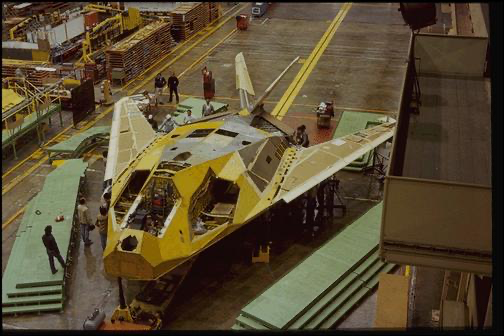
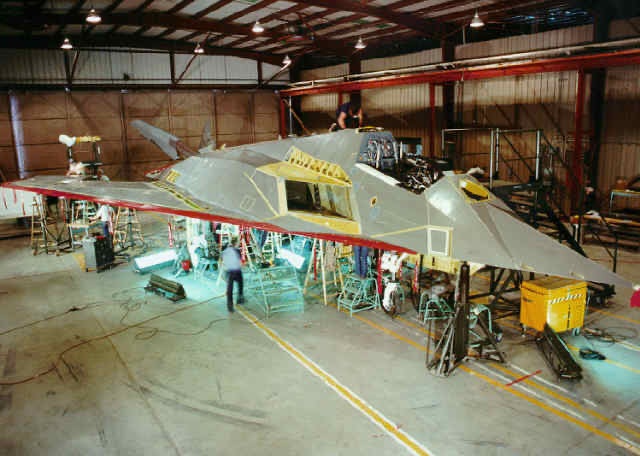
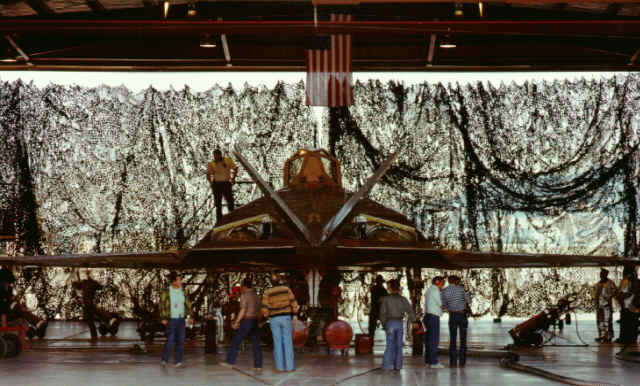
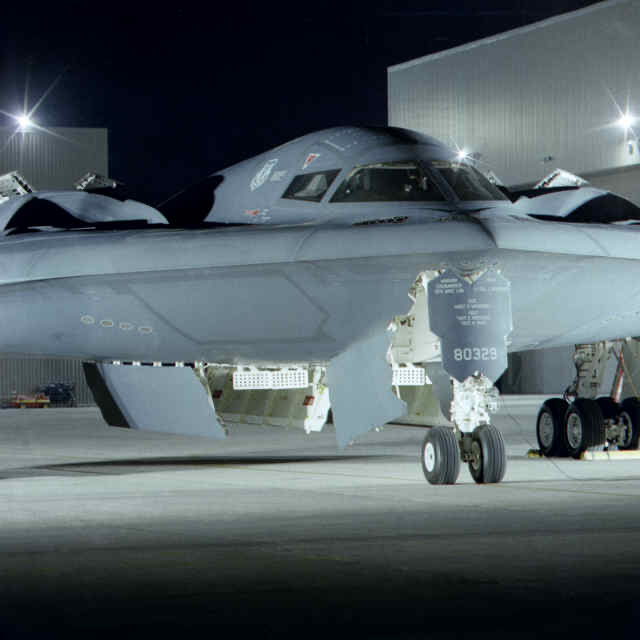
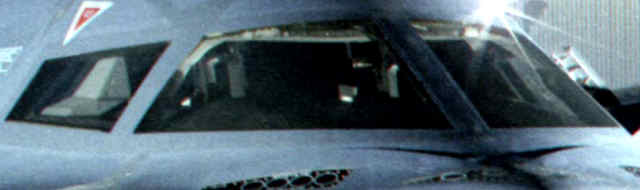
The gallery images associated with this technology are from a legacy image compilation whose CIA-P2 catalog numbers are legacy identifiers and do not establish CIA authorship, declassification, or provenance for these specific photographs. The images appear to show B-2 airframes during manufacturing, in flight, and in hangar environments, but the precise dates, locations, and photographic provenance of each image cannot be verified from the images alone.
References
- Northrop Grumman. "B-2 Spirit." Official product page.
- US Air Force. "B-2 Spirit Fact Sheet." Air Force Fact Sheets, www.af.mil.
- Crickmore, Paul. Northrop B-2 Spirit. Osprey Publishing.
- Goodall, James. America's Stealth Fighters and Bombers. Motorbooks International.
- National Air and Space Museum. "Northrop Grumman B-2 Spirit." Smithsonian Institution.
- Werrell, Kenneth. Death from the Heavens: A History of Strategic Bombing. Naval Institute Press.