
Overview
The Lockheed A-12 Oxcart was a single-seat, Mach 3+ high-altitude reconnaissance aircraft developed by Lockheed's Skunk Works for the Central Intelligence Agency under the code name Oxcart. It was the predecessor to the better-known SR-71 Blackbird and was the first aircraft capable of sustained cruise at speeds above Mach 3. The A-12 operated from 1963 to 1968, conducting reconnaissance missions over North Vietnam and North Korea from its base at Kadena Air Base, Okinawa.
The A-12 was a CIA programme, not an Air Force programme. It was developed in response to the need for reconnaissance of the Soviet Union that could survive the improving Soviet surface-to-air missile network that had shot down Francis Gary Powers' U-2 on 1 May 1960. The A-12's combination of extreme speed, extreme altitude, and low radar cross-section was intended to make it effectively invulnerable to contemporary air defences.
Design and Technology
The A-12 was a technological tour de force. Its airframe was built primarily from titanium — a material that Lockheed had never used in quantity before and that was in such short supply in the United States that the CIA covertly purchased titanium from the Soviet Union through third-party intermediaries to avoid alerting the Soviets to the programme.
The aircraft was powered by two Pratt & Whitney J58 turbo-ramjet engines, a unique propulsion system that functioned as a conventional turbojet at low speeds and progressively diverted bypass air to afterburner-equipped ramjet ducts at high speeds. At Mach 3 cruise, the engines operated primarily as ramjets, with the turbojet core contributing only a fraction of total thrust.
The A-12's radar cross-section was reduced through a combination of shape, materials, and radar-absorbent treatments. The chines — the sharp edges running along the fuselage sides — served both an aerodynamic function (generating lift at high speeds and high angles of attack) and a stealth function (deflecting radar energy away from the receiver). The aircraft's fuel was used as a heat sink for the airframe and avionics, and special high-flashpoint fuel (JP-7) was developed because conventional jet fuel would auto-ignite at the temperatures generated by Mach 3 cruise.
Development History
The A-12 programme began in 1957 when the CIA, concerned about the vulnerability of the U-2 to improving Soviet air defences, initiated a study for a follow-on reconnaissance aircraft. Lockheed's Skunk Works, which had built the U-2, submitted a proposal for a Mach 3 aircraft called Archangel (the name evolved through a series of design iterations designated Archangel-1 through Archangel-12, with the final design becoming the A-12).
In August 1959, the CIA selected Lockheed's A-12 proposal over a competing design from Convair (the Kingfish). The contract was awarded under the code name Oxcart. The programme was conducted in extreme secrecy: the aircraft were built at Lockheed's Burbank facility, disassembled, transported by road to the Groom Lake test site (Area 51) in Nevada, and reassembled for flight testing.
The first A-12 (Article 121, serial 60-6924) first flew on 26 April 1962 at Groom Lake, with Lockheed test pilot Lou Schalk at the controls. The aircraft exceeded Mach 1 on its first flight (inadvertently, during a dive) and reached Mach 2.1 on its second flight. The first flight at Mach 3 occurred in July 1962.
A total of 15 A-12s were built (including the prototype, five for training, and nine for operational reconnaissance). Two were lost in accidents, and one was lost when an Air Force drone launch went wrong.
Operational History
The A-12 achieved operational capability in 1965 and deployed to Kadena Air Base, Okinawa, in 1967 under the code name Black Shield. From Kadena, A-12s conducted reconnaissance missions over North Vietnam (searching for surface-to-air missile sites) and North Korea (searching for the USS Pueblo, seized in January 1968).
The A-12's operational career was short. The aircraft was expensive to operate, required extensive maintenance between flights, and the SR-71 — a larger, two-seat Air Force variant — was entering service and could perform the same mission with greater flexibility. The A-12 was retired in 1968, after only 13 months of operational service. The SR-71 continued flying until 1999.
The A-12 programme was not publicly acknowledged until 1981, when the CIA declassified its existence as part of a broader release of Cold War reconnaissance programme information.
Variants and Derivatives
- A-12 Oxcart: The original CIA single-seat reconnaissance aircraft. 15 built.
- YF-12A: A three-seat interceptor variant developed for the US Air Force, equipped with AIM-47 Falcon air-to-air missiles and an AN/ASG-18 fire-control radar. 3 built. The YF-12 programme was cancelled in 1968.
- M-21: A two-seat variant designed to carry and launch the D-21 reconnaissance drone. 2 built. The programme was cancelled after one M-21 was lost in a mid-air collision with its drone during a launch attempt.
- SR-71 Blackbird: A larger, two-seat Air Force reconnaissance derivative. 32 built. Operated from 1966 to 1999.
Specifications
| Parameter | Value | |---|---| | Role | Strategic reconnaissance | | Manufacturer | Lockheed (Skunk Works) | | First flight | 26 April 1962 | | Introduced | 1963 (operational 1965) | | Retired | 1968 | | Crew | 1 | | Length | 101 ft 7 in (30.99 m) | | Wingspan | 55 ft 7 in (16.95 m) | | Height | 18 ft 6 in (5.64 m) | | Empty weight | ~60,000 lb (27,200 kg) | | Max takeoff weight | ~124,000 lb (56,200 kg) | | Engines | 2 × Pratt & Whitney J58 turbo-ramjets | | Max speed | Mach 3.2+ (~2,200 mph / 3,540 km/h) | | Cruise speed | Mach 3.0+ | | Service ceiling | ~90,000 ft (27,400 m) | | Range | ~2,900 nmi (5,400 km) | | Built | 15 |
Declassification and Provenance
The A-12 Oxcart programme was declassified by the CIA in 1981. Surviving aircraft are on display at several museums, including the Intrepid Sea, Air & Space Museum (New York), the California Science Center (Los Angeles), and the USS Alabama Battleship Memorial Park.
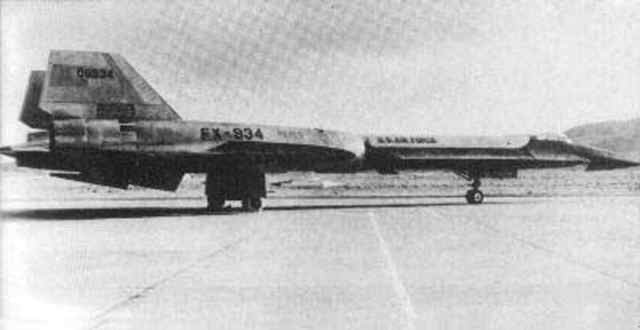
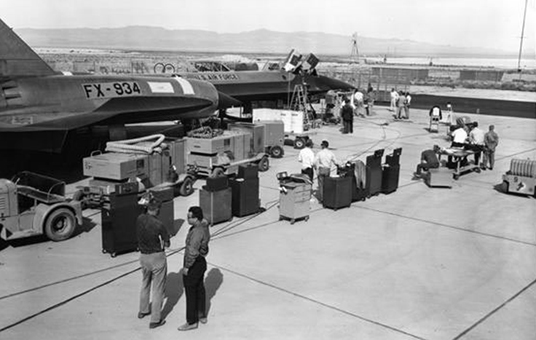
The gallery images associated with this technology are from a legacy image compilation whose CIA-P2 catalog numbers are legacy identifiers. While the A-12 was indeed a CIA programme, these specific photographs cannot be verified as CIA-origin or formally declassified through the FOIA process based on the images alone.
References
- CIA. "The Oxcart Story." Central Intelligence Agency, declassified.
- Merlin, Peter W. Design and Development of the Blackbird: Challenges and Lessons Learned. AIAA.
- Crickmore, Paul. SR-71 Blackbird. Osprey Publishing.
- Goodall, James. Lockheed's SR-71 'Blackbird' Family. Aerofax.
- Rich, Ben R. and Janos, Leo. Skunk Works. Little, Brown and Company.
- National Air and Space Museum. "Lockheed A-12." Smithsonian Institution.