
Overview
The Lockheed F-117 Nighthawk is a single-seat, twin-engine attack aircraft developed by Lockheed's Skunk Works division in the late 1970s and early 1980s. It was the first aircraft in history designed and built specifically to exploit radar cross-section reduction as its primary survivability mechanism. Although commonly called a "stealth fighter," the F-117 is strictly an attack aircraft with no air-to-air capability.
The F-117 entered operational service in 1983 at Tonopah Test Range, Nevada, but its existence was not officially acknowledged until 1988. The aircraft achieved public fame during Operation Desert Storm in 1991, where it was the only coalition aircraft to strike targets in downtown Baghdad and was widely credited with the campaign's most dangerous precision-strike missions. The F-117 was retired from US Air Force service in 2008, though a small number were maintained in flyable storage.
Design and Low-Observable Technology
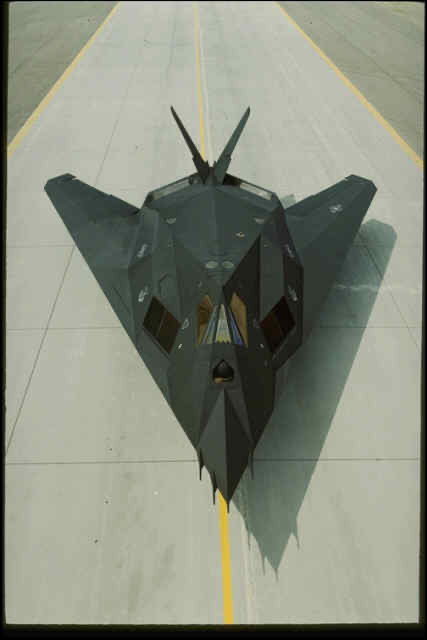
The F-117's angular, faceted appearance is a direct consequence of the computational limitations of the 1970s. The aircraft's shape was optimised using a software program called "Echo," developed by Lockheed mathematician Bill Schroeder under the direction of Skunk Works chief Ben Rich. Echo could calculate radar returns from flat panels but could not handle curved surfaces with the computing power then available. The result was an aircraft composed entirely of flat triangular and trapezoidal panels — a "hopeless diamond" shape that deflected radar energy in multiple directions.
The F-117's faceted shape was a first-generation stealth solution. Later aircraft such as the B-2 and F-22 used smooth curves made possible by more powerful computers. Despite its angular appearance, the F-117 achieved a radar cross-section reportedly on the order of 0.001 square metres — roughly the size of a steel ball bearing.
The aircraft is coated with radar-absorbent material (RAM) on all external surfaces. The engine intakes are covered with grilles coated with RAM to prevent radar energy from reaching the compressor faces. The exhaust is routed through narrow slot-like nozzles flattened into the wing trailing edge, designed to rapidly mix exhaust gases with ambient air and reduce infrared signature. The aircraft has no afterburners — speed was sacrificed for stealth.
Development History
The F-117's lineage traces to 1974, when the Defense Advanced Research Projects Agency (DARPA) invited Lockheed, Northrop, and other contractors to study the feasibility of a low-observable aircraft. Lockheed's Skunk Works, which had developed the U-2 and A-12/SR-71 for the CIA, submitted a design based on faceted-body radar cross-section analysis.
In 1975, Lockheed was awarded a contract to build two technology demonstrator aircraft under the code name Have Blue. The two Have Blue prototypes were built in total secrecy at Burbank, California, and tested at the classified Groom Lake (Area 51) facility in Nevada. The first Have Blue flight occurred on 1 December 1977. Both prototypes were lost in accidents, but the flight data validated the stealth concept.
In 1978, the Air Force awarded Lockheed a full-scale development contract for an operational stealth attack aircraft under the code name Senior Trend. The first of five full-scale development (FSD) F-117s flew on 18 June 1981 at Groom Lake. The first production aircraft was delivered in 1982. A total of 59 production F-117s were built (plus the five FSD aircraft), with the last delivered in 1990.
Operational History
The F-117 entered service with the 4450th Tactical Group at Tonopah Test Range in October 1983. The unit operated under deep secrecy: pilots flew at night, the aircraft were kept in windowless hangars during daylight, and the programme's existence was publicly denied. The Air Force officially acknowledged the F-117 on 10 November 1988, releasing a deliberately blurred photograph.
The F-117's combat debut came in Operation Just Cause (Panama, December 1989), where two aircraft dropped bombs on Rio Hato airfield. Its most famous operations occurred during Operation Desert Storm (January–February 1991): F-117s flew approximately 1,300 sorties, struck more than 1,600 high-value targets, and were the only aircraft to attack downtown Baghdad. No F-117s were lost to enemy action during Desert Storm.
The F-117 also participated in Operation Allied Force (Kosovo, 1999), where one aircraft (serial 82-806, Spirit of Missouri) was shot down by a Serbian SA-3 Goa surface-to-air missile on 27 March 1999. The pilot ejected and was rescued. The shootdown demonstrated that stealth was not invulnerability — the Serbian battery commander, Colonel Zoltán Dani, employed modified radar frequencies and tactics that detected the aircraft at a critical moment.
The F-117 saw further service in Operation Iraqi Freedom (2003) and Operation Enduring Freedom (Afghanistan). The aircraft was officially retired on 22 April 2008, with the last operational flight occurring in February 2008.
Variants
- F-117A: The only production variant. All 64 aircraft (5 FSD + 59 production) were F-117As.
- F-117N "Seahawk": A proposed naval variant offered to the US Navy in the 1990s. Not built.
- F-117 upgrade programmes: The aircraft received incremental avionics and coating upgrades throughout its service life, including the addition of GPS, improved targeting FLIR, and more durable RAM coatings.
Specifications
| Parameter | Value | |---|---| | Role | Stealth ground-attack aircraft | | Manufacturer | Lockheed (Skunk Works) | | First flight | 18 June 1981 (first FSD) | | Introduced | October 1983 | | Retired | April 2008 | | Crew | 1 | | Length | 66 ft 8 in (20.3 m) | | Wingspan | 43 ft 4 in (13.2 m) | | Height | 13 ft 9 in (4.2 m) | | Empty weight | ~29,500 lb (13,380 kg) | | Max takeoff weight | ~52,500 lb (23,800 kg) | | Engines | 2 × General Electric F404-F1D2 non-afterburning turbofans | | Thrust | 2 × 10,800 lbf (48 kN) | | Max speed | ~Mach 0.92 (subsonic) | | Combat radius | ~930 nmi (1,720 km) | | Service ceiling | ~45,000 ft (13,700 m) | | Weapons | Up to 5,000 lb (2,300 kg) of internal ordnance (typically 2 × GBU-10/12/27 laser-guided bombs or JDAM) | | Unit cost | ~$42.6 million (flyaway) | | Built | 64 (5 FSD + 59 production) |
Declassification and Provenance
The F-117 programme was declassified in November 1988 after five years of operational service. The aircraft's existence, design, and mission have been publicly documented in detail. However, certain technical specifications — particularly the exact radar cross-section, full composition of the radar-absorbent materials, and electronic warfare capabilities — remain classified.
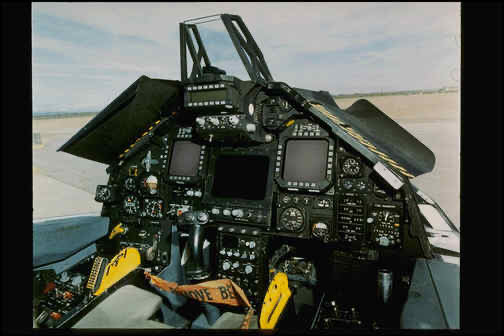
The gallery images associated with this technology are from a legacy image compilation whose CIA-P2 catalog numbers are legacy identifiers and do not establish CIA authorship, declassification, or provenance for these specific photographs. The images appear to show F-117 aircraft on the ground and in cockpit views, but the precise dates and locations cannot be verified from the images alone.
References
- Lockheed Martin. "F-117 Nighthawk." Historical product page.
- US Air Force. "F-117 Nighthawk Fact Sheet." Air Force Fact Sheets (archived).
- Crickmore, Paul. F-117 Nighthawk. Osprey Publishing.
- Goodall, James. America's Stealth Fighters and Bombers. Motorbooks International.
- Rich, Ben R. and Janos, Leo. Skunk Works. Little, Brown and Company.
- Sweetman, Bill. Stealth Aircraft. Motorbooks International.