
Overview
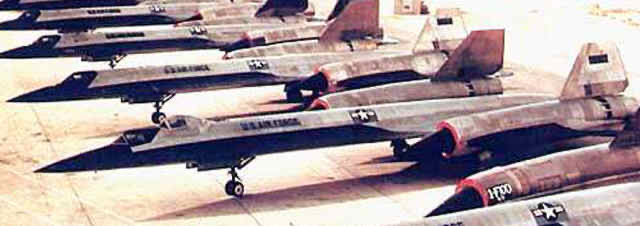
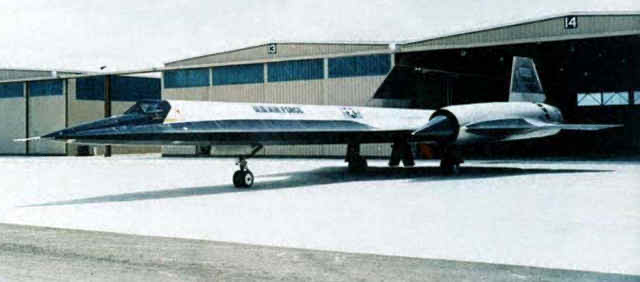
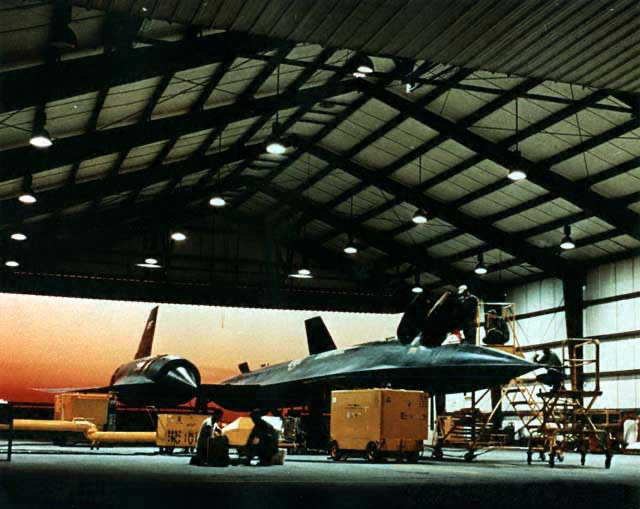
The Lockheed Blackbird family is a series of high-altitude, Mach 3+ aircraft developed by Lockheed's Skunk Works from the late 1950s through the 1960s. The family includes the CIA's A-12 Oxcart reconnaissance aircraft, the Air Force's YF-12 interceptor, the SR-71 Blackbird reconnaissance aircraft, the M-21 drone carrier, and the D-21 reconnaissance drone. All share the same fundamental airframe technology: titanium construction, chined fuselage, J58 turbo-ramjet engines, and JP-7 high-flashpoint fuel.
The Blackbirds remain the fastest air-breathing manned aircraft ever built. Their Mach 3+ cruise speed and 80,000+ foot service ceiling made them effectively invulnerable to interception by contemporary fighters and missiles. No Blackbird was ever lost to enemy action during operational reconnaissance missions.
Design and Technology
All Blackbirds share a common technological foundation:
Titanium construction: The airframe was built primarily from titanium (initially B-120, later variants), which retained its strength at the temperatures generated by Mach 3 cruise (leading-edge temperatures exceeded 600°F/315°C). The titanium was so scarce in the United States that the CIA covertly purchased it from the Soviet Union.
J58 turbo-ramjet engines: The Pratt & Whitney J58 was a unique propulsion system that operated as a conventional turbojet at low speeds and progressively diverted bypass air to afterburner-equipped ramjet ducts at high speeds. At Mach 3 cruise, the engines functioned primarily as ramjets.
JP-7 fuel: A specialised high-flashpoint fuel was developed because conventional jet fuel would auto-ignite at the temperatures generated by Mach 3 cruise. JP-7 has a flash point above 140°F (60°C) and required a special chemical ignition system (triethylborane) to ignite in the engine.
Chined fuselage: The sharp edges running along the fuselage sides served dual purposes: generating lift at high speeds and high angles of attack, and deflecting radar energy away from the receiver to reduce radar cross-section.
The A-12 Oxcart
The A-12 was the original Blackbird, developed for the CIA under the Oxcart programme. It was a single-seat reconnaissance aircraft that first flew on 26 April 1962 at Groom Lake. Fifteen A-12s were built. The aircraft operated from 1963 to 1968, conducting reconnaissance missions over North Vietnam and North Korea from Kadena Air Base, Okinawa. The A-12 was retired in 1968 in favour of the SR-71.
The YF-12 Interceptor
The YF-12A was a three-seat interceptor variant developed for the US Air Force. It was equipped with an AN/ASG-18 fire-control radar in a modified nose and could carry four AIM-47 Falcon long-range air-to-air missiles internally. Three YF-12As were built. The aircraft set several speed and altitude records in 1965, including a sustained speed of 2,070 mph (3,331 km/h) and an altitude of 80,257 feet (24,463 m).
The YF-12 programme was cancelled in 1968 by Secretary of Defense Robert McNamara, who judged that the aircraft was too expensive for the interceptor mission and that the Soviet bomber threat it was designed to counter was diminishing. The two surviving YF-12As were used by NASA for high-speed research until 1979.
The SR-71 Blackbird
The SR-71 Blackbird was a two-seat strategic reconnaissance aircraft operated by the US Air Force from 1966 to 1999 (with a hiatus from 1990 to 1995). It was the largest and most capable member of the Blackbird family, carrying a comprehensive sensor suite including optical cameras, side-looking radar, and signals intelligence equipment.
The SR-71 flew operational reconnaissance missions from Beale Air Force Base, California, and from forward operating locations at Kadena Air Base (Okinawa) and RAF Mildenhall (United Kingdom). The aircraft conducted missions over Vietnam, the Middle East, and other contested areas. No SR-71 was ever lost to enemy action. Twelve SR-71s were lost in accidents over the programme's lifetime.
The SR-71 was retired in 1990, briefly reinstated in 1995, and retired again in 1999. The aircraft remains a cultural icon of Cold War technological achievement.
The M-21 and D-21 Drone
The M-21 was a two-seat variant of the A-12 designed to carry and launch the D-21 reconnaissance drone (designated Tagboard). The D-21 was an unmanned, ramjet-powered reconnaissance vehicle designed to fly at Mach 3+ over hostile territory where a manned aircraft would be at risk. Two M-21s were built.
The M-21/D-21 programme was cancelled after a fatal accident on 30 July 1966: during the fourth D-21 launch attempt, the drone struck the M-21's rear fuselage, causing both aircraft to crash. The M-21 launch officer (Ray Torick) drowned after ejecting. The D-21 was subsequently modified for launch from a B-52 and flew a small number of operational missions over China before the programme was cancelled entirely.
Specifications
| Parameter | A-12 | YF-12A | SR-71A | |---|---|---|---| | Role | Reconnaissance | Interceptor | Reconnaissance | | Operator | CIA | USAF | USAF | | Crew | 1 | 3 | 2 | | First flight | 26 Apr 1962 | 7 Aug 1963 | 22 Dec 1964 | | Length | 101 ft 7 in | 101 ft 8 in | 107 ft 5 in | | Wingspan | 55 ft 7 in | 55 ft 7 in | 55 ft 7 in | | Max speed | Mach 3.2+ | Mach 3.2+ | Mach 3.2+ | | Service ceiling | ~90,000 ft | ~90,000 ft | ~85,000 ft | | Number built | 15 | 3 | 32 |
Declassification and Provenance
The A-12 programme was declassified in 1981. The SR-71 and YF-12 were publicly acknowledged from their first flights. Surviving Blackbirds are on display at museums across the United States, including the National Air and Space Museum (Washington, DC), the Imperial War Museum Duxford (UK), and the Museum of Flight (Seattle).
The gallery images associated with this technology are from a legacy image compilation whose CIA-P2 catalog numbers are legacy identifiers. While the A-12 was a CIA programme, these specific photographs cannot be verified as CIA-origin or formally declassified through the FOIA process based on the images alone.
References
- CIA. "The Oxcart Story." Central Intelligence Agency, declassified.
- Crickmore, Paul. SR-71 Blackbird. Osprey Publishing.
- Merlin, Peter W. From Archangel to Oxcart. NASA Dryden Flight Research Center.
- Goodall, James. Lockheed's SR-71 'Blackbird' Family. Aerofax.
- Rich, Ben R. and Janos, Leo. Skunk Works. Little, Brown and Company.
- Graham, Richard. SR-71 Revealed. Motorbooks International.